Top businesses aren't just optimising for Google.
They're already adapting to AI:
Ranking for classic search engines used to be the goal.
But answer engines (ChatGPT, Claude, etc) are taking over...
If you want your business to stay relevant,
You need to start investing in AI-driven rankings (AEO, GEO).
Organic traffic is still powerful...
But combining that with ranking highly for SEO/AEO/GEO is unbeatable.
In 2025, 3 types of search will dominate:
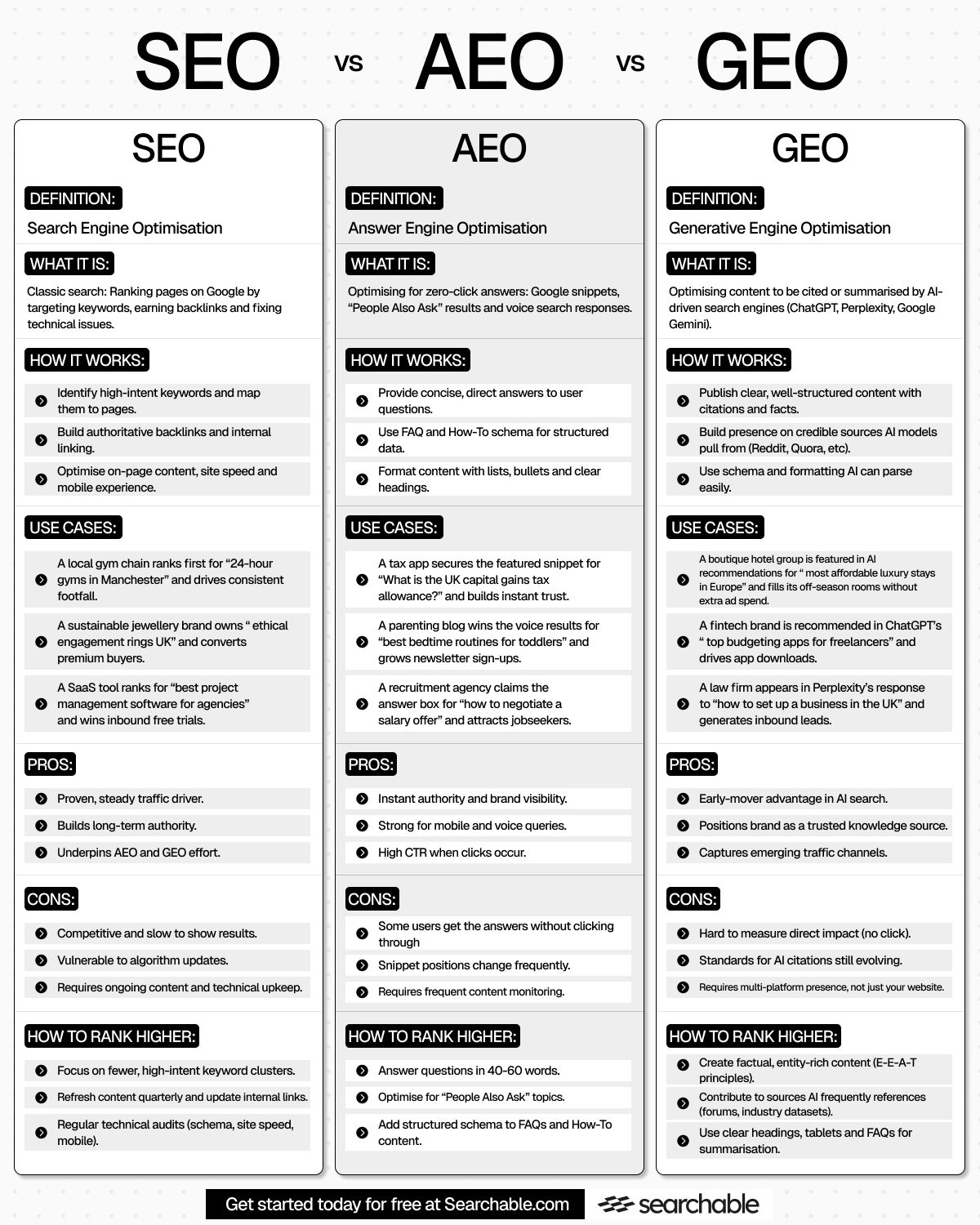
(See the cheat sheet for more details 👇)
SEO: Search Engine Optimisation
↳ Ranking pages on Google.
How it works:
- Identify high-intent keywords
- Build backlinks and internal linking
- Optimise content, speed and mobile experience
Pros:
↳ Consistent traffic driver
↳ Builds long-term authority
↳ Underpins AEO and GEO efforts
Cons:
↳ Competitive and slow to show results
↳ Vulnerable to algorithm updates
↳ Requires ongoing upkeep
How to rank higher:
↳ Focus on fewer, high-intent keyword clusters
↳ Refresh content quarterly
↳ Run technical audits
AEO: Answer Engine Optimisation
↳ Optimising for zero-click answers (like voice search)
How it works:
- Provide concise, direct answers
- Use schema mark-up (FAQ, How-to)
- Format content bullets and headings
Pros:
↳ Instant authority and visibility
↳ Strong for mobile and voice queries
↳ High CTR when clicks happen
Cons:
↳ Some users get the answer without clicking
↳ Snippet positions change frequently
↳ Requires constant content monitoring
How to rank higher:
↳ Answer questions in 40–60 words
↳ Optimise for “People Also Ask” queries
↳ Add schema markup to FAQ and How-To pages
GEO: Generative Engine Optimisation
↳ Optimising content pulled by AI-driven search engines (like ChatGPT)
How it works:
- Publish clear, well-structured content
- Build presence on credible sources (Reddit, Quora)
- Use AI-readable formatting
Pros:
↳ Early mover advantage in AI search
↳ Positions brand as a trusted source
↳ Captures future-facing traffic streams
Cons:
↳ Hard to attribute direct traffic
↳ AI citation rules are still evolving
↳ Requires off-site presence, not just on your domain
How to rank higher:
↳ Use entity-rich, fact-checked content
↳ Get cited on known AI training sources
↳ Prioritise clarity with FAQs, tables, lists
Don’t get buried by brands already adapting.
It's not about just ranking on Google anymore.
Your content is training machines that people trust for knowledge.
AI Is The New Search Engine
Like most people, your first experience with AI was novelty; composing a song or putting your mom’s head on Mr. T’s body. Next came informational asks: writing a legal defense to a speeding ticket or how to program your thermostat. What you’re not aware of is that you are slowly being conditioned to trust AI with larger and more important choices, including purchasing decisions.
And thus begins the battle over brand placement in AI search results.
What Is Traditional SEO?
Traditional SEO is the term for the collective tactics and strategies intended to influence the order in which search engines rank websites in organic search results. Traditional search results are the list of websites a search engine generates based on a query that was entered. While the tactics and strategies have changed over the last 20 years, the goal remained the same: get a website to rank in the top of search results where the traffic (and money) is.
What Is GEO?
GEO (generative engine optimization) is the term for the collective tactics and strategies intended to influence the information provided in AI answers. Instead of providing a list of websites from which a user does their own research, generative AI is designed to do the research for them and provide answers. Users gain trust quickly and make purchasing decisions based on what AI tells them.
Wait, So What Exactly Is The Difference Between SEO And GEO?
It’s important to understand that SEO and GEO are not separate methodologies; they mostly overlap. Think of it like this: If you made a list of all SEO tactics and selected those that influence AI the most, they would be called GEO.
Generative AI engines are more likely to recommend brands that are well-established authorities in their space with great reputations and proven to delight their customers. These are the same criteria traditional search engines use to rank websites. The same is true for technical and user-experience aspects.
For example, no different than traditional search engines, AI won’t recommend websites that load slowly, have coding errors or anything else that is an indication of a poor user experience. In GEO, more emphasis is placed on content layout. Traditional search engines look at webpages in their totality, where generative AI engines are looking for specific facts, quotes and passages to pull from within the content of each page.
What’s gone are mostly the gray- and black-hat hacks and loophole exploits, and anything like meta titles and descriptions whose only purpose is on the traditional search results page. For example, showering your website with backlinks or creating hundreds of location pages might impress traditional search engines, but are likely to be ignored by AI.
What Does All This Mean For Your Brand?
The bad news is that getting traffic from generative AI search will be even more difficult than traditional search. In traditional search, users are presented with a list of multiple websites to click through, and a website doesn’t necessarily need to be ranked No. 1 to get traffic—while most clicks went to the websites ranked at the top of the page, even the websites at the bottom get a small share of the pie. However, AI is more likely to make a single recommendation, meaning there’s only one winner and no second place.
The good news is that there is action you can take; you aren’t simply at the mercy of AI’s whims.
• Make your brand appear more influential and authoritative to AI by engaging in online conversations about your industry and providing free answers and information.
• Draw AI’s attention to important quotes and facts within your text using bulleted lists, pull quotes, bold, italics and underlines.
• AI is more likely to recommend websites with a great user experience that are free from bugs; use free tools such as Google’s Pagespeed Insights to find and fix technical errors.
• Come clean and stop using traditional black-hat SEO methods from this point forward.
Why You Should Welcome Generative AI Search
While you may roll your eyes and sigh because there’s a new technology to learn, this wasn’t the first and won’t be the last. Just like SEO, the moment you think you’re starting to understand GEO, the landscape will change once again.
As with any challenge your business faces, don’t pause here too long—do what you can and keep moving forward. For some of you, this means learning enough on your own to direct your own strategy. For others, you might need to hire someone to do it for you.
Probably the best words of wisdom I can give are: You don’t need the best GEO on the internet; you only need to do it better than your competition.